
Marine engine compatibility and post-trial inspection
This is a compatibility, safety and post-trial inspection study — not a fuel-economy study, and we do not present it as one. A Komatsu 6M108AP-1 marine main engine ran treated for 1,875 operating hours in scheduled service, was then opened at a shipyard and examined by the engine manufacturer’s own service agent, which found no treatment-related damage and no corrosion. On carbon deposits the two parties disagree — the research group reports less in the treated cylinders, the inspecting company records no significant difference — and we publish both. Every fuel figure from the same programme is excluded from what we claim — the reason is set out below.

An engine opened, not a claim made
The work formed the closing stage of an industry–university joint research project into the use of the treatment on vessels, run with Hiroshima Merchant Marine Technical College using its own small training ship, the “Hikari”, out of the college’s pier in the waters around Osakikamijima, Hiroshima Prefecture. The ship is a two-engine, two-shaft vessel: over the trial, one Komatsu 6M108AP-1 main engine was treated and the other was not, in the same hull, on the same voyages.
At the end of the programme the vessel was docked at Ishida Shipbuilding Co., Ltd., a long-established yard that also handles docking for government agencies, and the main engine was opened. The inspection itself was carried out by Kyowa Industries Co., Ltd., the service agent for Komatsu, a company whose business is inspecting, repairing and overhauling marine engines, generators and gas turbines. Neither company sells the treatment or has a commercial interest in the result.
The scope covered the turbocharger, the cylinder head, the intake manifold and the exhaust manifold, followed by a sea trial after reassembly. The academic side of the joint research group was reported by Assistant Professor Iwakiri of the college.
| Inspected | Finding | Recorded by |
|---|---|---|
| Cylinder head | Combustion chamber in good condition on both sides | Inspecting company |
| Carbon deposit, treated vs untreated | Two different readings. The research group’s report and the supervising academic’s summary both record less carbon adhesion in the treated cylinders. The inspecting company’s own work report records no significant difference in fouling between the two engines and their intake and exhaust systems. | Research group and inspecting company — they differ |
| Intake manifold | No corrosion and no effects attributable to the treatment | Inspecting company |
| Exhaust manifold | No significant difference between the two sides | Inspecting company |
| Turbocharger | Opened and inspected; no abnormality reported | Inspecting company |
| Overall | Both engines in good condition in every part; no corrosion or other effect from applying the treatment to the port engine | Inspecting company, verbatim |
What the paperwork actually says
Two documents sit behind this page: the work report written by the inspecting company, and the completion notice issued by the yard. Their contents are set out here in full. We do not reproduce the documents themselves — both are marked confidential and carry a named inspector, a company seal and a director’s address.
| Recorded | Value |
|---|---|
| Client | Hiroshima Merchant Marine Technical College |
| Inspecting company | Kyowa Industries Co., Ltd., Engine Division — service agent for Komatsu |
| Yard | Ishida Shipbuilding Co., Ltd., Onomichi, Hiroshima Prefecture |
| Vessel | Training ship “Hikari” — two engines on two shafts |
| Engine model | Komatsu 6M108AP-1 |
| Engine numbers | Starboard #21813 (untreated) · port #21814 (treated) |
| Operating hours at opening | 1,875 h |
| Work title | Intake and exhaust system open maintenance |
| Docking period | 18 – 25 August 2023 |
| Scope of work | Turbocharger, cylinder head, intake manifold and exhaust manifold each opened and inspected, followed by a sea trial after reassembly |
The remarks field of the work report, in full
- “In this maintenance there was no significant difference in the fouling inside the main engines on either side, or in the intake and exhaust systems.”
- “No effects such as corrosion from applying the agent to the port engine were observed either.”
- “Both engines were in good condition in every part.”
Translated from the Japanese work report; a native-speaker review is pending and the Japanese wording governs. The assignment of port as the treated side is stated in the study report, which records the treatment as applied on the port side. The remarks are given in full rather than in extract, because the first of them limits what we can claim — see the carbon row above.
What the engine ran like after reassembly
After the engines were put back together, the yard ran a sea trial and the manufacturer’s service agent logged operating parameters for both engines at five points through the morning. We reproduce that record below. Read it as documentation of the sea trial, not as evidence of an effect — the reasons are set out underneath it, and they are the reasons we do not build a claim on it.
| Time | Engine-room speed, stbd / port (rpm) | Untreated (°C) | Treated (°C) | Difference |
|---|---|---|---|---|
| 10:10 | 1000 / 1020 | 180 | 170 | −10 |
| 10:25 | 1500 / 1500 | 350 | 320 | −30 |
| 10:35 | 2270 / 2250 | 400 | 400 | 0 |
| 10:55 | 2490 / 2490 | 420 | 400 | −20 |
| 11:20 | 590 / 590 | 150 | 150 | 0 |
Why this is documentation and not evidence
- Exhaust temperature is not fuel consumption. It is consistent with several explanations, including plain differences between two individual engines, and it cannot be converted into a saving.
- These are two separate engines with their own histories. The same record shows their lubricating-oil pressures differ as well — and nobody attributes that to the treatment.
- The speeds are not identical at every point. Only at 10:25 and 10:55 did both engine rooms read the same figure. At 10:10 the treated engine ran 20 rpm faster and still read 10 °C lower; at 10:35 it ran 20 rpm slower and read the same.
- It is one sea trial, on one morning. Five readings per engine.
- No fuel was measured during this run. Nothing here changes the exclusion of the fuel figures set out below.
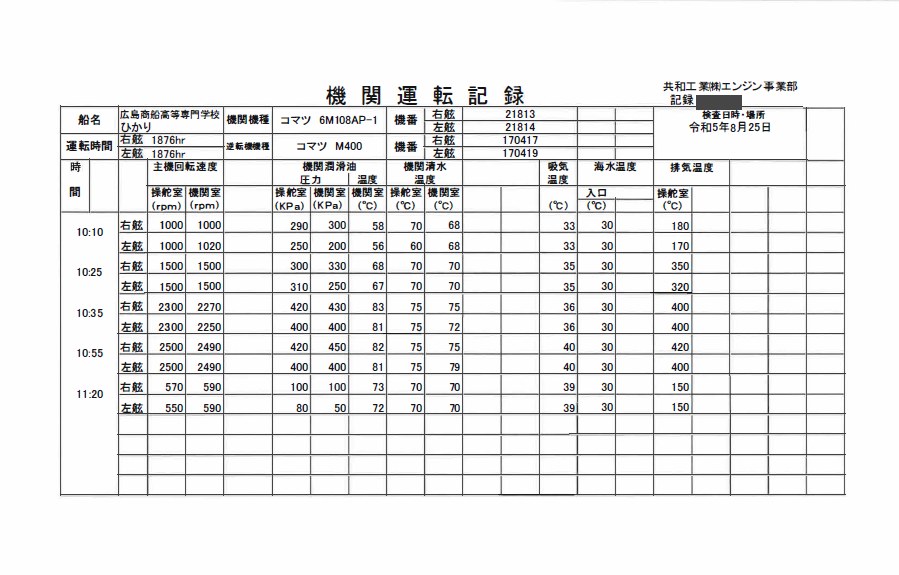
The operating record itself, logged by the engine manufacturer’s service agent on 25 August 2023 during the sea trial. Each time of day carries two rows: 右舷 starboard, the untreated engine, above 左舷 port, the treated one. The rightmost column is exhaust temperature. The name of the individual who filled in the form is redacted; the company that recorded it is named on the form and in our text. Open the scan at full size → — on a phone it is too small to read otherwise.
Reproduced from the study report with the operator’s permission (confirmed 16 August 2026). Personal data of the recording technician removed; no other alteration was made to the document. The form is in Japanese and we have not translated it in place — the table above carries the figures we read from it, and anyone reading Japanese can check them against the scan.
Four statements, and nothing beyond them
These are the only claims we draw from this programme. Each one is bounded by what was actually inspected, and each carries the limit of the method that produced it.
| Statement | What it rests on | Where it stops |
|---|---|---|
| Marine engine compatibility demonstrated under the conditions tested | The treatment was applied to a real Komatsu 6M108AP-1 marine diesel main engine in scheduled service on a training ship, and the engine was subsequently opened and examined. The report records no anomalies in the intake or exhaust system. | One engine model, one vessel, one measured interval. It supports rather than settles the question for other engine types. |
| No treatment-related engine damage or corrosion identified at post-trial inspection | The engine opening and technical assessment by the manufacturer’s service agent found no corrosion or damage attributable to the product. | An inspection finding after 1,875 hours, not a durability guarantee over an engine’s full life. |
| Lower carbon deposition reported by the research group — not by the inspecting company | The joint research group’s report and the supervising academic’s summary both record less carbon adhesion in the treated cylinders. | The inspecting company’s own work report says the opposite: “no significant difference” in fouling between the two engines. We give you both readings because they are both in the same document set. It is in no case a general claim that the product removes carbon deposits, and nothing here was quantified — both readings are visual. |
| A visible improvement in exhaust appearance was observed | The report describes a change in exhaust colour from the scavenging pipe and suppressed white smoke on the treated side. | No instrumented, quantitative emissions measurement was carried out on the vessel. This is an observation, not a measured emissions reduction. |
Why no fuel percentage from this study appears anywhere
The same programme also measured fuel consumption on the water. We use none of those figures — not the weak ones, and not the flattering ones. This is the part of the page most suppliers would simply leave out.
Fuel consumption data from this trial are intentionally excluded from performance claims, because the treatment was applied only once during an extended operating period and therefore did not reflect the currently recommended marine reapplication protocol.
- What is excluded
- Every fuel-saving percentage from this trial series, in both directions. The series contains a short run that came out substantially better than anything we claim anywhere, and a long run close to zero. Neither appears on this page, on any other page of this site, or in our sales material.
- Why the whole series and not just the weak run
- Because excluding only the unflattering half would be selective, and excluding only the flattering half would be modesty rather than method. If the application protocol does not match the product as it is supplied and used, the series does not measure that product — and that objection applies to a high result exactly as much as to a low one.
- The report reaches the same conclusion
- For its own weakest run the report attributes the result to insufficient application volume, alongside seasonal outside temperature and total running time. We are not inventing a reason; we are applying the study’s own caveat consistently to both runs.
- A combined “total” in the report
- The report also states a single combined figure across both runs. It cannot be reconstructed from its own two published results, and merging an 8-voyage run with a 47-voyage run into one headline is not a defensible method in any case. We do not use it, and we do not repeat it here.
- Why the numbers are not restated even to reject them
- The same reason we withdrew an earlier NOx claim rather than restating it: a figure we do not stand behind should not sit on our domain at all, where it can be extracted and attributed to us.
- Method limitations stated in the report
- Both engines sit in the same engine room, so some carry-over of the treatment to the untreated engine cannot be excluded. The treatment was applied via impregnated gauze wrapped around the filter rather than directly onto it. Individual measurement runs were 40 minutes.
Strong on safety, silent on savings
Read it for what it is
- It does establish that after 1,875 operating hours the treatment caused no corrosion, no damage and no abnormality in the intake and exhaust systems of a marine diesel engine — assessed by the manufacturer’s own agent, not by us.
- It does establish operational feasibility: the treatment was applied to an engine in scheduled service and the vessel ran its normal programme throughout.
- It does not settle the carbon question. The research group reports less carbon adhesion in the treated cylinders; the inspecting company’s own work report records no significant difference in fouling. Neither reading was quantified.
- It does not establish a fuel saving. Fuel was measured, and we exclude every one of those figures from what we claim — see the section above for why.
- It does not establish an emissions reduction. The exhaust was observed, not measured; no instrumented emissions equipment was fitted to the vessel.
- It does not transfer automatically to every engine type. It is one engine model, in one vessel, over one measured interval.